

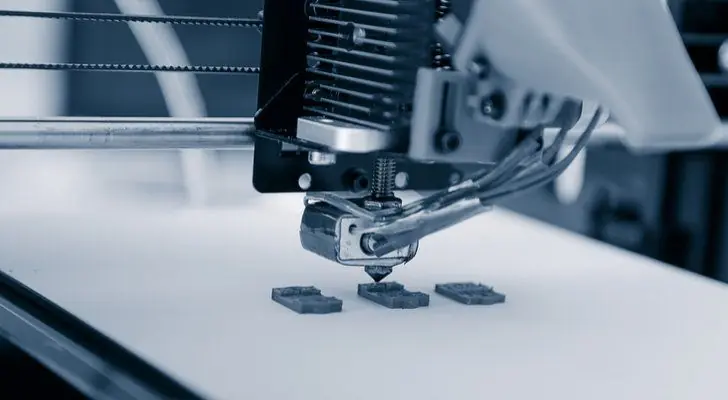
3D rapid prototyping is a set of techniques that quickly turn a CAD model into a physical prototype, without building a mold. Today it relies mainly on additive manufacturing, which builds the part layer by layer using different technologies: filament-based (FDM), liquid resin-based (SLA, DLP, MultiJet Printing) or powder-based (SLS, Multi Jet Fusion). It is used to check the form, fit and function of a plastic part before investing in a production mold.
What is 3D rapid prototyping?
Rapid prototyping is the process of physically producing a full-scale prototype of a part. It starts from a three-dimensional CAD model of the object, which is then printed with one of the many technologies available on the market. Compared with conventional machining, 3D rapid prototyping has shorter lead times and needs no dedicated tooling such as molds.
In new product development, 3D rapid prototyping is a strategic step: it lets you test the product, find errors and weak points and fix the design before moving on to series production. Changing a CAD model costs far less than modifying a mold that has already been built.
The real strengths of the process are speed, low cost for small quantities and a high degree of customization.
A closer look at additive manufacturing
Additive manufacturing is a rapid prototyping technique that builds the prototype by adding material layer by layer.
It is the fastest and most widely used option for prototypes and small batches because it:
- gives designers a lot of design freedom and room for customization
- can produce very complex geometries that are hard or impossible to achieve with other processes
- offers several surface finish options
- cuts cost and lead time for low quantities compared with processes that need dedicated tooling
- offers materials that effectively simulate the final thermoplastic polymer.
Additive manufacturing technologies for 3D rapid prototyping fall into three main families, depending on the state of the starting material: solid, liquid and powder. Here is an overview.
Which 3D rapid prototyping technologies can you use?
Solid-based technologies
Fused deposition modeling (FDM), also called fused filament fabrication (FFF): the most widely used 3D rapid prototyping technology. A thermoplastic filament, supplied on spools, is melted in a heated nozzle and deposited layer by layer. It is a fast process and relatively inexpensive, ideal for simple prototypes and form and fit checks. On the downside, accuracy and fine-detail resolution are lower than with resin-based technologies, layer lines remain visible and the bond between layers is the weak point of the part, so without finishing an FDM prototype is not well suited to cosmetic applications. Printable materials include standard and biodegradable polymers such as ABS, PLA and PC and, on industrial printers, high-performance polymers such as PPSF (polyphenylsulfone) and PEI (polyetherimide).
Liquid-based technologies
Stereolithography (SLA): a liquid photopolymer resin held in a vat is cured (hardened) layer by layer by a UV laser. SLA produces complex parts with very fine detail and an excellent surface finish, which makes it a good fit when you need high-precision or appearance prototypes, for example in the medical, dental and engineering fields. On the downside, photopolymer resins are generally more brittle than thermoplastics, so SLA parts can be more fragile.
Digital light processing (DLP): similar to stereolithography, except that the resin is cured by a digital projector instead of a laser. The projector exposes each whole layer at once rather than tracing it point by point, so printing is generally faster. In-plane resolution depends on the projector's pixel size.
MultiJet Printing (MJP): a material jetting technology in which print heads, similar to those of inkjet printers, deposit droplets of photopolymer resin that a UV lamp cures layer by layer. Wax is used as support material and is melted away after printing.
MultiJet Printing offers excellent detail definition and smooth surfaces, and resins are available with different properties, for example rigid, clear or rubber-like. It is best suited to appearance and precision prototypes and small batches.
Powder-based technologies
Selective laser sintering (SLS): a roller or blade spreads a thin layer of polymer powder over the build platform, usually polyamide (nylon) PA12 or PA11, sometimes filled; a laser beam selectively fuses the powder where the part is formed, then the platform lowers and the cycle repeats. The unfused powder supports the part during the build, so no support structures are needed: SLS is ideal for parts with very complex geometries. SLS parts are stronger and have better mechanical properties than resin parts made by stereolithography; on the other hand, the surface is rougher, because the material is grainy, and fine details are less sharp than with SLA.
Multi Jet Fusion (MJF): like SLS, it works on layers of powder, usually polyamide PA12, but instead of a laser it uses print heads and an infrared heat source. On each layer of preheated powder, the print heads apply a fusing agent where the part will be formed and a detailing agent along the edges, which limits fusion and keeps edges sharp. The infrared lamp then passes over the layer and fuses only the powder treated with fusing agent.
Multi Jet Fusion is one of the most productive powder-based technologies, well suited to strong functional prototypes and short runs of nylon parts.
Conclusions
3D rapid prototyping is used across a very wide range of industries. Its versatility, speed and low cost make it a key step in the pre-production phase: a prototype lets you validate the part before investing in a mold.
Bemar Plast offers 3D printing and rapid prototyping in FDM, SLA and MJF through a qualified service bureau in Italy and manages the whole project, so you have one point of contact from prototype to production. Once the part is validated, we design the mold and move on to plastic injection molding in our own plant in San Giovanni Ilarione, near Verona, Italy.
Contact us for an assessment of your project and a quote for the 3D prototyping technology that best suits your product.
Frequently asked questions
What is the difference between rapid prototyping and 3D printing?
3D printing is today the most common way to do rapid prototyping, but not the only one. Rapid prototyping covers any technique that quickly turns a CAD model into a physical prototype; 3D printing (additive manufacturing) does it by building the part layer by layer, with no dedicated tooling.
Which 3D printing technology should I choose for a plastic prototype?
It depends on what the prototype has to prove. FDM suits fast, low-cost form and fit checks; SLA suits fine detail and smooth surfaces, for example appearance models; MJF suits strong nylon parts for functional testing and short runs.
Does a 3D-printed prototype have the same properties as an injection-molded part?
No: even when the material is similar, layer-by-layer building gives different mechanical properties and surface finish from an injection-molded part. To validate performance with the production material, you need parts injection molded in the final material.
Which 3D printing technologies does Bemar Plast offer?
FDM, SLA and MJF, through a qualified external service bureau in Italy. Bemar Plast manages the whole project, so you have a single point of contact from prototype to production. See our 3D printing and rapid prototyping service.
When should I move from prototyping to injection molding?
When the form and function of the part are validated and you need production quantities: for plastic injection molding we recommend batches of at least 1,000 parts. We design the mold in-house and have it built by partners in Italy or China, as the customer prefers.