

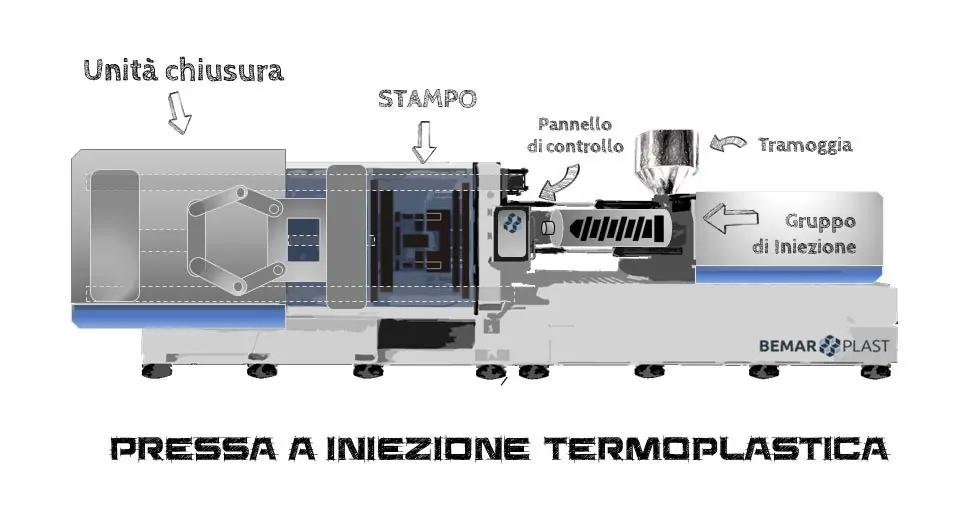
Thermoplastic injection molding is the industrial process in which a polymer is melted in an injection molding machine and injected under pressure into a mold, where it cools and takes the shape of the part. It produces finished components in volume, including complex geometries, with high repeatability and a low cost per part. The process relies on three elements: the injection molding machine, the mold and the auxiliary equipment.
A brief history
Injection molding of thermoplastics is used to make parts from both commodity polymers and engineering plastics. Molded parts usually come out of the mold finished: they need no secondary machining such as turning or CNC milling. The process also delivers high production rates at low operating costs.
Injection molding as we know it today took hold in the 1950s, when the reciprocating screw machine became widespread: the screw rotates to plasticize the material, then moves forward like a ram to inject it into the mold.
This article focuses on the molding process and on the equipment it involves.
Advantages of thermoplastic injection molding
Thermoplastics get their name from the way they respond to heat: they soften until they flow, then become solid again as they cool. Within limits, this cycle can be repeated, unlike with thermosets. Semi-crystalline polymers such as PP, PA and POM have a well-defined melting point; amorphous polymers such as ABS, PC and PMMA soften gradually above their glass transition temperature.
The main advantages of the process are:
- finished parts straight from the mold, including textures and cosmetic finishes
- high productivity and excellent process repeatability
- parts ranging from very small to large, including complex geometries
- parts in two or more colors or materials, including parts with metal inserts
- a high degree of automation
- a wide choice of materials, from commodity polymers such as polypropylene (PP) to engineering plastics such as polyamide (PA, nylon).
Machines and equipment used in injection molding
Injection molding requires several machines and pieces of equipment working together so that every stage of the process runs as it should.
The injection molding machine
Thermoplastic parts are molded on an injection molding machine, also called an injection press, which can be horizontal or vertical.
Horizontal machines are the most common. They consist of two main units:
- the injection unit
- the clamping unit.
The injection unit, usually on the operator's right, plasticizes (melts) the polymer and injects it into the mold. Its main components are:
- the feed hopper, often fitted with the dryer and the masterbatch doser
- the barrel, heated by electric heater bands
- the screw and the nozzle, which delivers the melt to the mold
- the motor that rotates the screw during screw recovery and the drive that pushes it forward during injection.
On the operator's left is the clamping unit, which opens and closes the mold and keeps it closed during injection. It consists of:
- the stationary platen, which carries the mold half on the injection side
- the moving platen, which carries the moving mold half and slides along the tie bars
- the clamping mechanism, toggle or hydraulic, which generates the clamping force
- the ejection system, which pushes the molded part out of the mold
- the electric motor or hydraulic system that drives the unit.
A control system manages the whole machine, regulating temperatures, pressures, speeds and times at every stage of the process.
Horizontal machines come in electric, hydraulic and hybrid versions, chosen according to production needs. Machine size is expressed as clamping force in metric tons: our molding shop runs 13 machines from 10 to 480 t, two of which are equipped for two-component molding.
Auxiliary equipment
Depending on the part, various auxiliary units are mounted on the clamping or injection unit, or installed beside the machine, to support the process.
Examples include dryers and dehumidifiers, loaders, dosing units and blenders, mold temperature controllers, conveyors, granulators, sprue pickers and robots. At Bemar Plast, for example, each of the 13 lines has its own dehumidifying dryer, temperature controller and beside-the-press granulator, and 9 lines are served by 3-axis electric robots.
The injection mold
Put simply, the mold is a tool made of two halves. This is where the part takes shape: the melt is injected into the cavity that defines its geometry and solidifies as it cools. A mold can have one or more cavities and contains the runner system, the cooling circuits and the ejection system.
The mold determines much of the quality of the part. That is why Bemar Plast handles injection mold design in-house, while mold building is entrusted to partner toolmakers in Italy or China, at the customer's choice.
The stages of thermoplastic injection molding
Injection molding is a complex process made up of many steps that must be set and controlled precisely. The main ones are:
- blending, where needed, of virgin polymer with additives, fillers, reinforcements, recycled material or color masterbatch
- drying or dehumidifying the polymer to remove excess moisture
- feeding the material from the hopper to the screw
- setting screw speed and back pressure
- plasticizing: the material melts, mostly from the shear heat generated by the rotating screw and partly from the barrel heaters
- injecting the melt into the mold, followed by the holding (packing) phase, which compensates for shrinkage
- cooling the part in the mold, with the mold temperature kept constant by a temperature control unit; meanwhile, the screw prepares the shot for the next cycle
- opening the mold and ejecting the part with the ejector pins
- removing the part, by an operator or a robot, where needed
- closing the mold to start the next cycle.
Process technicians set all parameters on the machine's control panel before production starts. During production, the computerized controller holds the set values cycle after cycle.
In short, these steps fall into three main phases:
- plasticizing and injection
- mold filling, holding and cooling
- mold opening and part ejection.
Types of injection molding
Several injection molding techniques make it possible to produce parts in more than one polymer or color, or parts that include non-thermoplastic components. Here are some examples:
- Conventional molding: the process described above, with a single material.
- Two-shot molding (2K, two-component or two-color): two materials or colors are molded in a single cycle using two injection units. The mold is often mounted on a rotary table: after the first shot, the table rotates and the second material is injected over or next to the first. Additional injection units make it possible to mold more than two materials or colors.
- Co-injection: two materials are injected in sequence through the same gate, producing a part with an outer skin and an inner core of a different material, for example a recycled core under a cosmetic surface.
- Overmolding and insert molding: plastic is injected onto a pre-made component placed in the mold, such as metal inserts (bushings, threaded inserts, electrical pins) or a rigid plastic substrate to be covered with a thermoplastic elastomer. The result is a single part, with no gluing or secondary assembly.
- Micro molding: molding very small, lightweight parts on low-tonnage machines with small shot sizes.
At Bemar Plast we perform conventional molding, two-shot molding on rotary tables, co-injection, overmolding and micro molding in-house.
Conclusion
Thermoplastic injection molding has been Bemar Plast's core business since 1995. In our plant in San Giovanni Ilarione, near Verona, Italy, we work under an ISO 9001:2015 certified quality system and mold mainly technical components in engineering plastics, as well as commodity polymers, using both new molds and molds supplied by the customer.
Find out more about our plastic injection molding service, and if you have a project to develop or a part to mold, contact us for technical advice or a quote.
Frequently asked questions
Which materials can be injection molded?
Most thermoplastics can be injection molded, from commodity polymers such as PP, ABS and PS to engineering plastics such as PA (nylon), POM, PBT and PC. Bemar Plast mainly molds engineering plastics, as well as commodity polymers; the choice depends on the performance the part requires.
Why does the resin need drying before molding?
Because hygroscopic polymers such as PA, PBT and PC absorb moisture from the air and, if molded wet, show cosmetic defects (splay, bubbles) and lose mechanical properties. That is why the pellets go through a dryer or dehumidifier before the hopper: at Bemar Plast every molding line has its own dehumidifying dryer.
What is the difference between two-shot molding and co-injection?
In two-shot (2K) molding, two materials or colors form separate, visible areas of the part, molded in a single cycle with two injection units, often with the mold on a rotary table. In co-injection, both materials enter through the same gate and form an outer skin and an inner core. Bemar Plast performs both techniques in-house.
At what volume does injection molding pay off?
Injection molding pays off in series production, because the cost of the mold is spread over the parts produced. At Bemar Plast the recommended minimum batch is 1,000 parts, depending on the project, up to one million parts per year for a single part number; early prototypes are made by 3D printing.
Can Bemar Plast mold parts with a mold I already own?
Yes, molding with customer-supplied molds, whether transferred from another supplier or built for the customer, is Bemar Plast's core business. The mold always remains the customer's property and, on request, is stored in our mold warehouse. For new projects we handle mold design in-house.